If you’re the only one who knows how to perform critical parts of your firm’s work, you don’t have a staffing issue. You have a systems issue.
Most bookkeeping firms rely on a mix of memory, experience, and quick on-the-fly explanations. That approach can work when you’re small, but it quickly becomes a liability as you grow. Client work becomes inconsistent, deadlines get tight (or slip), and delegation becomes stressful.
This is where bookkeeping SOPs come in.
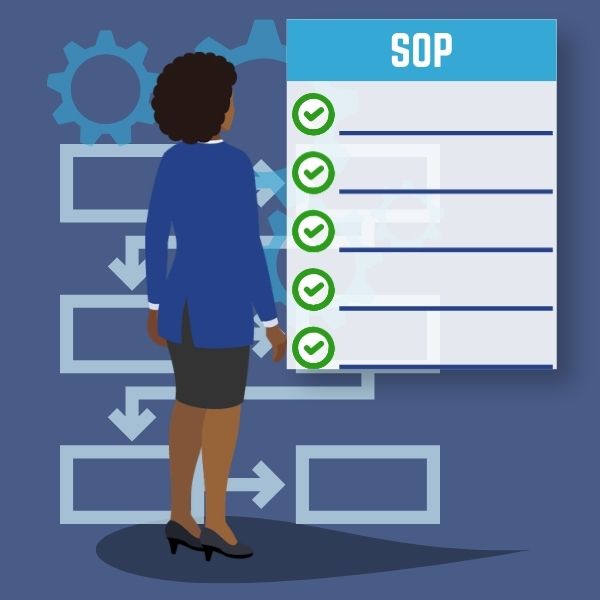
Standard Operating Procedures (SOPs) give your firm a clear, repeatable way to deliver services. They transform what’s in your head, your knowledge capital, into something your entire team can execute with confidence. This guide walks you through creating SOPs step by step so your firm can be more consistent, efficient, and profitable.
What Are Bookkeeping SOPs and Why Do They Matter?
Bookkeeping SOPs are documented instructions that define exactly how your firm performs its work. They are not meant to teach someone accounting from scratch. Instead, they capture your firm’s specific way of doing things so that every client receives the same level of service, no matter who completes the work.
Without SOPs, your firm relies heavily on individuals. With SOPs in place, your firm relies on systems. That shift is what allows you to scale, delegate, and maintain quality– all at the same time.
This becomes especially important if you’re working on fixed-fee engagements. Once pricing is fixed, your only lever for profitability is efficiency. The only way to control efficiency consistently is to standardize how work is done
Step 1: Start by Defining Your Services
Before you can document how work is done, you need to be clear on what work you actually do. This is your service list, an essential tool in creating SOPs, instituting fixed-fee pricing, and controlling scope creep.
Many firms skip this step and jump straight into writing procedures. That usually leads to incomplete or inconsistent SOPs because the list of services is not clearly defined.
Take the time to outline all your services, including recurring work such as monthly bookkeeping and reporting, as well as one-time projects such as cleanups or consulting. It’s also worth identifying the tools you use and the types of clients you serve. This context helps ensure your SOPs are relevant and practical.
Clearly defining your services is the foundation of delivering consistent, profitable work. Without that clarity, everything that follows becomes harder to standardize
Step 2: Document Exactly How the Work Gets Done
Once your services are defined, the next step is to document how each one is performed.
This is where you create your procedure guides. These are detailed descriptions of the steps involved, the tools used, and any firm-specific rules or best practices to follow.
This part takes effort. It forces you to slow down and think through processes you’ve likely been doing automatically for years. But it’s also one of the most valuable exercises you can do for your firm.
You’re not writing a textbook. You’re capturing your firm’s experience. That includes the shortcuts, the checks, and the small decisions that make your process work smoothly.
A good way to approach this is to think in clear, directive terms. You’re not suggesting options. You’re defining how your firm operates. Be specific. Think:
“This is how we do things here.”
Not:
“Here’s one way you could do it.”
Step 3: Translate Procedures into Actionable Checklists
Procedure guides are important, but they are not what your team will use day to day. That role belongs to checklists.
Each procedure guide should be paired with a checklist that breaks the process into clear, sequential steps. These steps should be specific enough to leave no ambiguity about what needs to be done.
For example:
❌ “Log into QuickBooks” (this is too general and doesn’t give specific directions)
✅ “Navigate to QBO > Vendor Center and review Open Bills filter” (gives very specific directions)
This level of detail may feel excessive at first, but it’s what eliminates guesswork and ensures consistency. Over time, these checklists become the backbone of your firm’s daily operations, guiding your team through each task with clarity and precision
Step 4: Account for Tools and Variations
Not all clients and workflows are identical, and your SOPs should reflect that reality.
If your firm uses different tools or follows slightly different processes depending on the situation, those differences should be clearly documented. If you try to force everything into a single massive SOP that covers all the variances, it will be confusing, hard to follow, and most likely never used.
Instead, create variations where necessary and be explicit about when each one applies. This ensures your team knows exactly which process to follow in each scenario, reducing errors and increasing efficiency.
Step 5: Make SOPs Easy to Access
Even the best SOPs are useless if your team can’t find them when they need them.
Your procedure guides, checklists, and supporting resources should be centralized and easy to access. When someone is working on a task, they should be able to move through the entire process without stopping to search for information or ask questions.
This includes access to client details, documents, and any tools required to complete the work. When everything is organized and readily available, your team can complete tasks more efficiently and with fewer interruptions
Step 6: Integrate SOPs into Your Workflow
Documenting SOPs is only half the job. The real impact comes when they are integrated into your firm’s workflow.
This means assigning tasks, setting schedules, and ensuring that each piece of work is tied to a clear process. Everyone on your team should know what they are responsible for, when it needs to be completed, and exactly how to do it.
A structured workflow system like Aero Workflow connects your SOPs to actual work being performed. It ensures that procedures are not just documented, but actively followed as part of your firm’s daily operations
Step 7: Use SOPs to Confidently Delegate
Delegation becomes much easier when your processes are clearly documented.
One of the biggest challenges firm owners face is the fear that work won’t be done correctly without their involvement. Strong SOPs address that concern by providing clear guidance and expectations.
When your team has access to well-defined procedures and checklists, they can complete their work independently without constant supervision. This not only frees up your time but also creates a more empowered and capable team.
Over time, your staff can also contribute improvements to your processes, strengthening your firm’s overall knowledge base and making your systems even more effective
Step 8: Track Performance and Improve
Once your SOPs are in use, they begin to generate valuable insights.
By tracking how long tasks take and identifying where delays or issues occur, you can refine your processes and improve efficiency. This data also helps you make better decisions about pricing, staffing, and workload management.
A centralized workflow system makes it easier to collect and analyze this information, giving you a clearer picture of how your firm is performing and where there is room for improvement
Step 9: Keep Your SOPs Current
SOPs are not something you create once and forget about. As your firm evolves, your processes will change, and your documentation needs to keep up.
In today’s world, the tools we use are constantly evolving, and our SOPs need to evolve right along with them. If SOPs become outdated, your team will stop relying on them. That’s when inconsistency starts to creep back in. Treat your SOPs as a living system that grows alongside your firm.
Make it a habit to review and update your SOPs regularly. Encourage your team to provide feedback and suggest improvements. In my firm, each member of my team is a “czar” of certain apps. They are responsible for keeping up with changes and improvements to their apps and ensuring that the relevant SOPs stay up to date. We rotate “czar” positions every six months so that everyone can have a chance to learn about each app in depth.
How SOPs Help You Scale Your Firm
When your bookkeeping SOPs are clear, accessible, and integrated into your workflow, your firm operates very differently.
Work becomes more predictable. Delegation becomes more natural. Onboarding new team members becomes faster and less stressful. Most importantly, your firm is no longer dependent on any one person to function effectively.
This is what allows you to step back from day-to-day tasks and focus on growing your business. With the right systems in place, your firm can deliver consistent results while continuing to expand.
About the Author: Laura Redmond

Related Posts